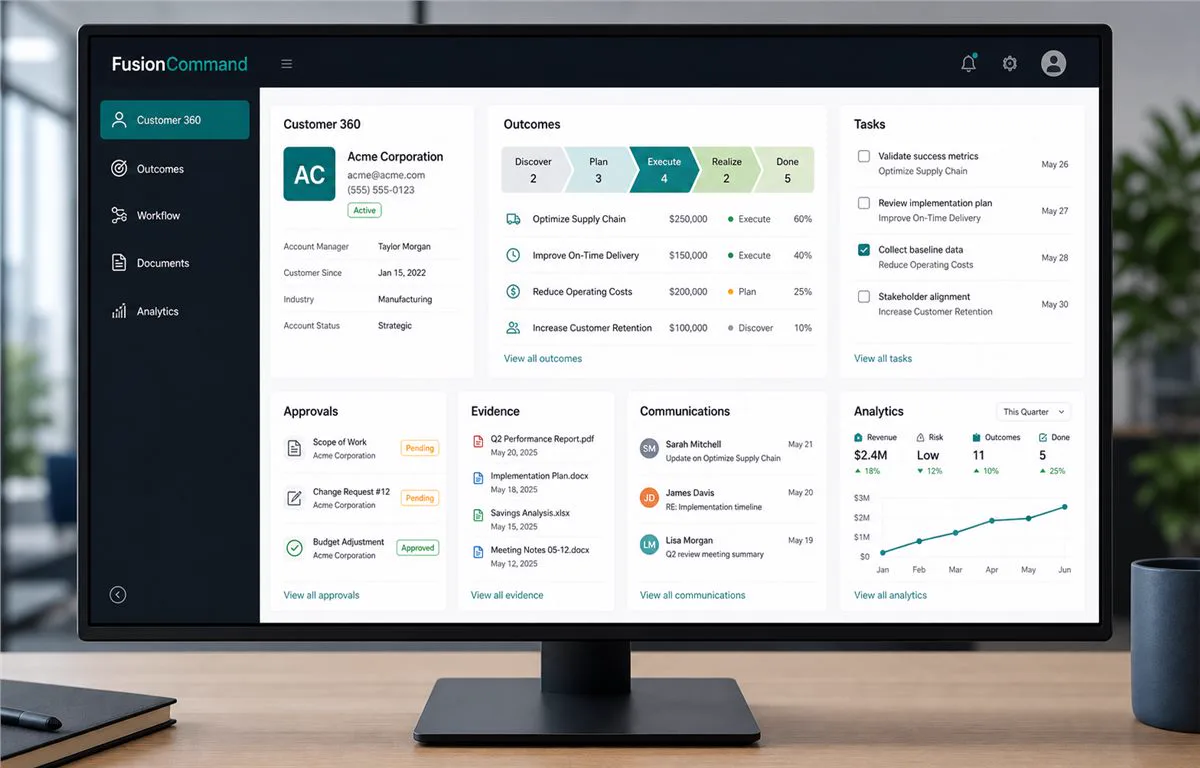
What Command CRM brings together.
WHAT IT ENABLES
Customers, accountable work, workflows, evidence, and required outcomes remain visible within one operational model.
Customers in context
01See organizations, people, agreements, history, opportunities, obligations, communications, documents, and current work together.
Work that has an owner
02Connect tasks, departments, permissions, approvals, alerts, follow-ups, and deadlines to accountable people and outcomes.
Workflow-defined operations
03Model how work moves, what evidence it requires, how exceptions are handled, and which measurable result completes it.
Role-specific workspaces
04Give sales, service, management, finance, purchasing, inventory, fulfillment, and other teams focused views over governed shared records.
Management oversight
05See workload, overdue work, readiness, risk, approvals, service and financial indicators, and the evidence supporting each operational status.
Bounded customer and partner portals
06Invite customers and partners into messages, requests, documents, approvals, statements, and service updates without exposing internal authority.
Permissions and activity history
07Keep read access, oversight, and consequential actions distinct while recording material changes across related work.
Connected communication
08Use Engage and Fusion Bridge to connect conversations, providers, and external systems.
Evidence over guesswork
09Record decisions, events, conflicts, exceptions, and completion instead of relying on scattered updates.
Local-first deployment
10Run on Fusion Web Server, Fusion OS, or both, with core operations available without an internet connection.