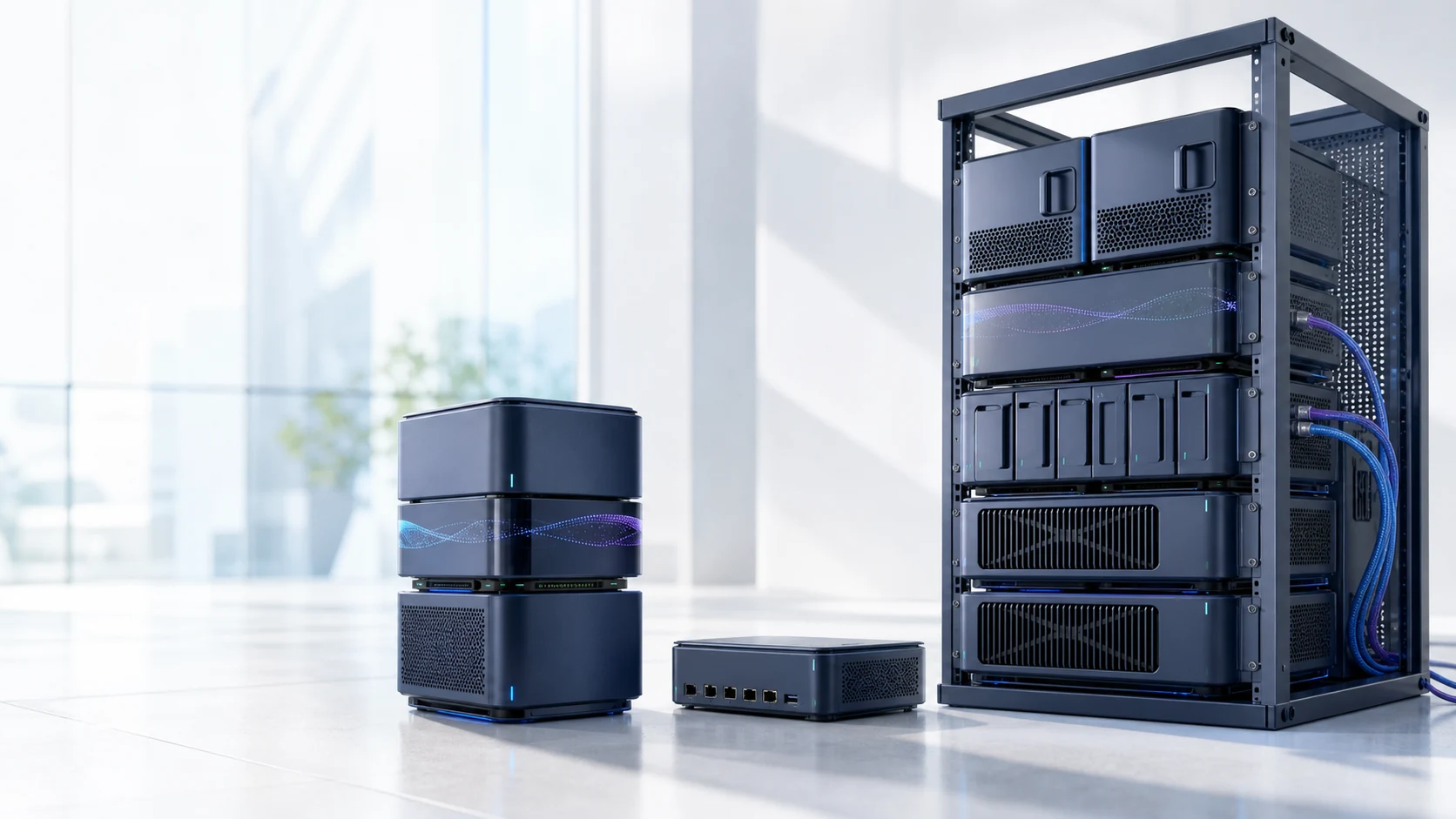
What Fusion Matrix brings together.
WHAT IT ENABLES
A family of active-data appliances expands verified working sets, buffers, caches, high-bandwidth memory, and overflow close to eligible compute.
Fusion Matrix Solo
01A compact active-data appliance for expanding an individual workstation’s verified working sets, buffers, caches, and fast local overflow.
Fusion Matrix Pro
02A high-bandwidth active-data system for creative, AI, analytical, simulation, and production workflows with larger shared working sets.
Fusion Matrix Business
03A serviceable business and studio appliance for governed shared data, concurrent teams, replicas, failure domains, and rack deployment.
Fusion Matrix Cloud
04A modular rack-scale active-data system for private cloud, datacenter, distributed working sets, provider locality, and horizontally expanded capacity.
FusionData active-data layer
05FusionData manages logical DataObjects independently of physical providers while preserving generation, content hash, locality, topology, integrity, provenance, leases, and retention.
Active data, not persistent storage
06Hold decoded frames, tensors, audio buffers, analytical datasets, caches, and intermediate results; durable files remain governed by Fusion VFS and Vault.
Immutable generations
07Identify objects by DataObject ID and monotonic generation, verify integrity on reads and transfers, and use only replicas whose generation and hash match the catalog.
Placement and replicas
08Manage ownership, leases, replicas, failure domains, checkpoints, expiration, cleanup, and failover without exposing unsafe remote pointers or claiming arbitrary cache coherence.
Direct provider paths
09Move large working sets directly between authorized data and compute providers through resumable, content-verified transfers rather than the control plane.
Locality-aware execution
10Keep active data close to an eligible Core or other provider and let FusionRuntime weigh hops, bandwidth, congestion, health, and transfer cost.
Technology-neutral evolution
11Support practical DRAM and NVMe overflow while keeping provider contracts open to HBM, pooled memory, persistent memory, CXL-class systems, and future technologies.