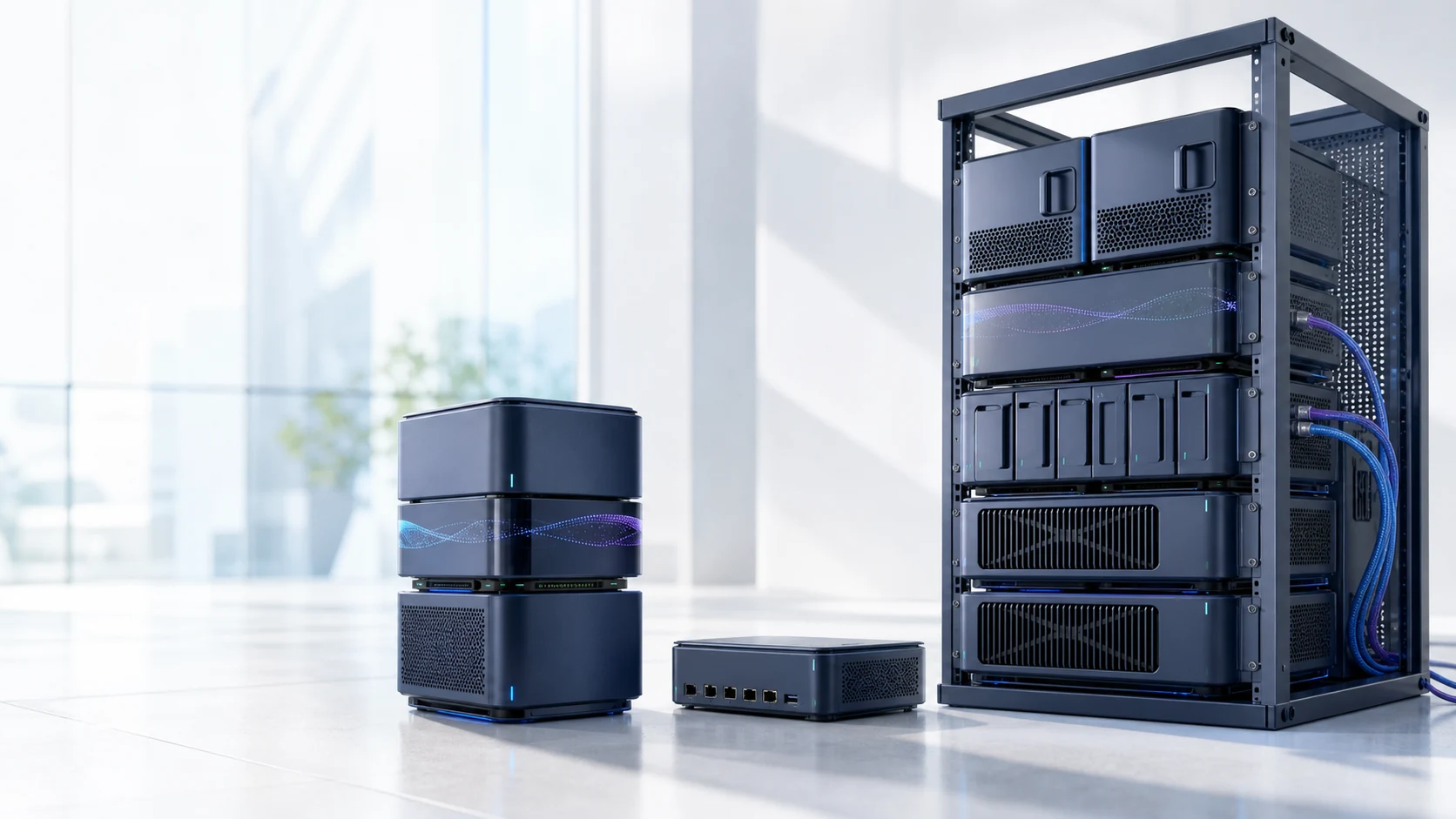
What Fusion External Appliances brings together.
WHAT IT ENABLES
Core, Matrix, Vault, and accessory modules share Fusion Fabric from compact computers and stage systems to production racks and datacenter pools.
Fusion Fabric connection interface
01Core, Matrix, Vault, and approved accessory devices share discovery, topology, authorization, health, lifecycle, and efficient parallel data-path contracts instead of behaving like unrelated peripherals.
Fusion Core · compute
02Add CPU, GPU, NPU, FPGA, DSP, media, AI, and compression capabilities through compact, professional, business, rack, and cloud-scale configurations.
Fusion Matrix · active data
03Expand topology-visible working sets, buffers, caches, shared data, high-bandwidth memory, and NVMe-backed overflow close to eligible compute.
VaultX · persistent storage
04Extend high-speed, compression- and deduplication-aware storage from smartphone-sized portable appliances through desktop arrays, business racks, and datacenter systems.
Modules that become a computer
05Combine the right Core, Matrix, Vault, and I/O modules into a compact self-contained Fusion computer while keeping each capability independently serviceable and replaceable.
Accessory and hybrid devices
06Network, USB, media, control, sensor, and other local hubs can join the fabric, while hybrid devices can combine more than one role when a smaller deployment benefits from tighter integration.
Stage, studio, and FOH proximity
07Modules can become focused stage devices, and nearby equipment racks can connect directly to a production computer or mixing position when the physical layout supports a short fabric path.
Rack and server-farm scale
08Larger systems use rack devices, fabric connectors, and cables to add parallel compute and data capacity while preserving bandwidth, latency, congestion, trust, and failure-domain topology.